

 Blog
Blog
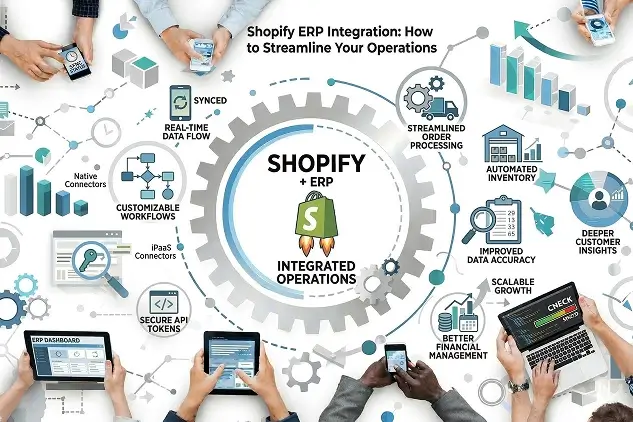


For many successful ecommerce brands, efficient operations are the foundation of growth. One of the most powerful tools businesses use to achieve this efficiency is ERP (Enterprise Resource Planning).
ERP systems help companies manage and connect multiple business processes within a single platform—such as inventory, procurement, manufacturing, supply chain management, sales, and financial operations.
When integrated with Shopify, an ERP system can significantly improve operational efficiency by ensuring that data flows seamlessly across your entire business ecosystem.
Understanding Shopify ERP Integration
Shopify ERP integration refers to connecting your Shopify store with an ERP system so that both platforms can automatically share and synchronize data.
With this integration in place, important business data such as:
- Inventory levels
- Order details
- Customer information
- Financial records
are updated in real time across all systems.
This eliminates the need for manual data entry, reduces human errors, and improves the accuracy of your business operations.
Businesses can integrate Shopify with ERP systems using several methods, each offering its own benefits.
Methods for Integrating Shopify With ERP Systems
Custom Integrations
Custom integrations involve building a tailored connection between Shopify and your ERP system.
Developers align the ERP system’s API with Shopify’s API to create a solution specifically designed for your business workflows.
This approach provides maximum flexibility but typically requires significant development resources and time.
Native or Vendor-Built Integrations
Many ERP providers offer prebuilt integrations that connect directly with Shopify.
These solutions are designed to support common ecommerce workflows and are often easier to implement compared to custom integrations.
Native integrations are typically more cost-effective and faster to deploy since they require minimal technical customization.
Integration Platform as a Service (iPaaS)
iPaaS is a cloud-based solution that simplifies integration between different applications.
With iPaaS platforms, businesses can create automated workflows that connect multiple systems—including ERP, CRM, and ecommerce platforms—without managing complex infrastructure.
This approach is particularly useful for organizations that require scalable and flexible integrations.
Key Benefits of Shopify ERP Integration
Integrating Shopify with an ERP system can transform the way businesses manage operations, leading to greater efficiency and improved decision-making.
Here are some of the most important advantages.
1. Improved Inventory Management
One of the biggest benefits of ERP integration is better control over inventory.
By synchronizing Shopify with your ERP system, inventory levels are updated in real time, ensuring that stock levels always reflect actual availability.
This helps businesses:
- Prevent stockouts that lead to lost sales
- Reduce excess inventory and storage costs
- Maintain optimal stock levels across warehouses
With accurate inventory data, companies can make smarter purchasing and distribution decisions.
2. Streamlined Order Processing
ERP integration automates the entire order management workflow.
When a customer places an order on Shopify, the information is instantly synced with the ERP system. This automatically triggers processes such as order picking, packing, and shipping.
Automation eliminates manual data entry, speeds up fulfillment, and improves delivery efficiency—ultimately enhancing customer satisfaction.
3. Improved Data Accuracy
Accurate data is essential for making informed business decisions.
ERP integration ensures that data remains consistent across all systems, reducing discrepancies between platforms.
For example:
- Inventory updates remain synchronized across multiple warehouses
- Financial reports reflect accurate sales data
- Customer data stays consistent across CRM systems
This unified data environment allows businesses to gain a clearer understanding of performance and operations.
4. Stronger Customer Relationship Management
By integrating Shopify customer data into your ERP system, businesses gain deeper insights into customer behavior.
This includes information such as:
- Purchase history
- Browsing behavior
- Engagement metrics
These insights enable businesses to create personalized marketing campaigns and deliver more relevant product recommendations.
Understanding customer preferences also helps brands strengthen relationships and improve customer retention.
5. Better Financial Management
ERP systems improve financial management by automating accounting tasks and providing real-time financial insights.
Sales transactions from Shopify are automatically transferred to the ERP system, reducing manual accounting work and minimizing errors.
This integration allows businesses to monitor:
- Revenue and expenses
- Profitability
- Cash flow
With accurate financial data readily available, companies can make more informed financial decisions.
6. Scalability for Business Growth
As ecommerce businesses grow, managing larger order volumes and expanding sales channels becomes increasingly complex.
ERP integration helps businesses scale efficiently by automating operational processes and improving communication between departments.
This allows companies to focus on strategic growth initiatives rather than spending time on manual operational tasks.
Step-by-Step Guide to Integrating ERP With Shopify
Integration between Shopify and ERP systems typically occurs through APIs (Application Programming Interfaces). APIs enable different platforms to communicate and exchange data seamlessly.
Many integrations are delivered through Shopify apps or iPaaS solutions that simplify the process.
Below is a simplified process for integrating ERP with your Shopify store.
1. Generate API Tokens
Start by creating API tokens for your ERP system and Shopify store. These tokens allow the systems to securely exchange data.
2. Define Workflow Processes
Determine how data will flow between the systems.
For example, you may define workflows for:
- Inventory synchronization
- Order processing
- Customer data updates
- Product information management
3. Establish System Connections
Configure communication pipelines that allow Shopify and the ERP system to exchange data efficiently.
4. Map and Customize Data
Data mapping ensures that fields from Shopify correspond correctly with fields in your ERP system.
For example, a “New Customer” entry in your ERP system could automatically trigger a welcome email campaign in your marketing platform.
5. Schedule Data Synchronization
Decide how frequently data should be synchronized.
Some businesses choose periodic updates, while others prefer real-time synchronization for immediate data accuracy.
Popular ERP Systems That Integrate With Shopify
Many leading ERP solutions support Shopify integrations, including:
- NetSuite
- Acumatica
- Brightpearl
- Microsoft Dynamics
For example, the NetSuite Shopify integration allows businesses to sync orders, inventory, and financial data between both systems.
Many companies also work with certified integration partners to customize these connections based on their operational needs.
Frequently Asked Questions
Can Shopify integrate with ERP systems?
Yes, Shopify supports ERP integrations through its Global ERP Program and third-party connectors. Popular ERP systems such as Microsoft Dynamics and Oracle NetSuite can integrate with Shopify to automate data synchronization and business workflows.
Does Shopify integrate with SAP?
Yes, Shopify can integrate with SAP through third-party applications or custom API integrations. This allows businesses to synchronize inventory, orders, and financial data between both systems.
What is a Shopify integration?
A Shopify integration connects your Shopify store with external tools or systems—such as ERP platforms, CRMs, and marketing automation software—to streamline operations and improve overall business efficiency.
Final Thoughts
Shopify ERP integration can significantly improve the way ecommerce businesses operate. By connecting your Shopify store with an ERP system, you can automate workflows, maintain accurate data across platforms, and improve operational efficiency.
From inventory management to financial reporting and customer insights, ERP integration helps create a unified business environment that supports scalability and long-term growth.
For growing ecommerce brands, implementing ERP integration is not just an operational improvement—it is a strategic investment in building a more efficient and scalable business.