

 Blog
Blog
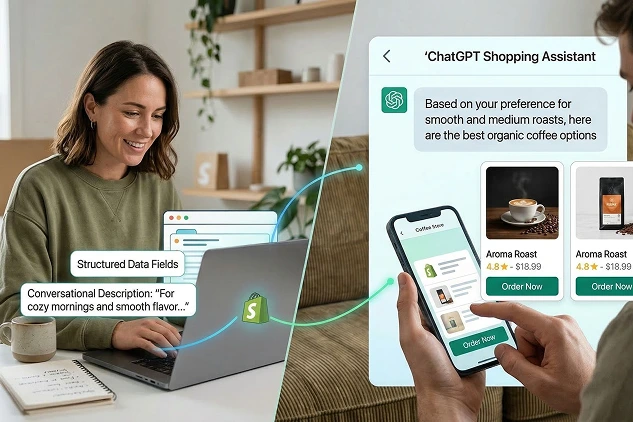


Ecommerce is entering a new phase where discovery is no longer limited to search engines or social media. With the rise of conversational AI, shopping is becoming more direct, personalized, and intent-driven.
Since its rollout in 2025, ChatGPT Shopping has introduced a new way for customers to find and compare products. Instead of browsing multiple websites, users can simply ask a question and receive curated product recommendations instantly.
For Shopify merchants, this represents a major shift. It creates an opportunity to reach high-intent buyers without relying heavily on paid ads. As adoption grows, optimizing your store for AI-driven discovery is becoming essential.
Understanding ChatGPT Shopping: What It Is and How It Works
ChatGPT Shopping integrates ecommerce directly into conversational interfaces. When a user searches for something like “best organic coffee under $100,” the system presents a curated list of products with images, pricing, ratings, and purchase links.
The experience feels like interacting with a personal shopping assistant. Instead of scanning dozens of pages, users receive a refined selection based on relevance and intent.
This system relies on:
- Structured product data
- Clear and contextual descriptions
- Customer reviews and sentiment
- Website performance and trust signals
Unlike traditional search engines, ChatGPT focuses less on keyword density and more on how well your content aligns with real user queries.
Why This Shift Matters for Shopify Merchants
The scale of this change is significant.
Conversational AI is expected to influence nearly 40 percent of ecommerce purchases by 2026, up from around 15 percent in 2024. At the same time, millions of users are already relying on AI tools to guide buying decisions.
What makes this important is the intent behind these interactions. Users asking questions in ChatGPT are often closer to making a purchase. This means:
- Higher conversion potential
- Lower customer acquisition costs
- More qualified traffic
Merchants who adapt early can benefit from increased visibility without increasing ad spend.
How Ranking Works in ChatGPT Shopping
Ranking in ChatGPT Shopping is fundamentally different from traditional SEO.
Instead of focusing heavily on keywords, the system evaluates:
Contextual relevance
Your product content must match how people naturally ask questions.
Data clarity
Well-structured information about pricing, availability, and features improves visibility.
Authentic reviews
Real customer feedback plays a major role in determining which products are recommended.
Website performance
Fast-loading, reliable stores are prioritized.
Trust signals
Transparent policies, brand credibility, and consistency matter more than ever.
This shift rewards merchants who focus on user experience rather than technical shortcuts.
How to Integrate Your Shopify Store with ChatGPT Shopping
Getting started does not require complex development. A few foundational steps can significantly improve your chances of being discovered.
Step 1: Allow crawler access
Ensure your Shopify store allows AI crawlers such as OAI SearchBot to access your content. This is done through your robots.txt file. Without this step, your products may not be indexed.
Step 2: Submit your product feed
OpenAI is introducing product feed submissions that allow merchants to directly share their product data. This increases visibility and ensures your listings are prioritized over standard crawling.
Step 3: Add structured data
Structured data helps AI systems understand your products more effectively.
You can use Shopify apps to automatically implement schema for:
- Product details
- Pricing
- Availability
- Reviews
This improves how your products are interpreted and displayed.
Step 4: Build strong trust signals
AI systems evaluate the credibility of your store.
You should include:
- A detailed About Us page
- Clear return and shipping policies
- Customer testimonials
- Business credentials
These elements increase both user trust and AI confidence in your store.
5 Lesser-Known Ways to Rank Higher in ChatGPT Shopping
Beyond technical setup, there are strategic approaches that can significantly improve your visibility.
1. Create pages based on real user queries
Think about how customers phrase questions.
For example:
- “Best gifts for new moms under $50”
- “Comfortable sneakers for travel”
Create dedicated collection or landing pages around these queries. This aligns your content directly with user intent.
2. Turn reviews into conversational content
Encourage customers to write reviews in a natural, story-like format.
Instead of generic feedback, aim for:
“I needed comfortable shoes for long trips, and these worked perfectly.”
This type of content mirrors how users interact with AI and improves relevance.
3. Write product descriptions as narratives
Avoid purely technical descriptions.
Instead, focus on storytelling:
Describe how the product fits into a user’s life, solves a problem, or improves an experience.
This makes your content more engaging and easier for AI to interpret.
4. Build centralized review hubs
Create dedicated pages that collect reviews, images, and customer feedback for each category.
This allows AI systems to better understand overall sentiment and product quality. It also strengthens your authority within a niche.
5. Use AI-driven prompts in marketing
Encourage customers to interact with AI tools using your brand.
For example, suggest queries like:
“Ask ChatGPT for the best skincare products from our store.”
This creates external signals and increases the likelihood of your products being referenced.
Keeping Your Store Optimized and Measuring Performance
Optimization is not a one-time effort. It requires ongoing updates and analysis.
Maintain accurate product data
Keep product titles, descriptions, and inventory updated. Ensure your content reflects real search intent rather than outdated keywords.
Focus on site performance
Page speed remains critical. Optimize images, reduce unnecessary scripts, and ensure your store loads quickly across devices.
Encourage continuous reviews
Customer feedback is a key ranking factor. Use post-purchase emails to collect reviews and display them prominently.
Build authority through expertise
Go beyond product listings.
Share:
- Sourcing details
- Brand story
- Industry knowledge
This aligns with trust-based ranking signals and improves credibility.
Track and refine regularly
While direct attribution is still evolving, you can measure impact through:
- Traffic patterns
- Engagement metrics
- Custom discount codes
- Landing page performance
Regular testing and refinement are essential to maintain visibility.
ChatGPT vs Google: Competing or Complementary
Many merchants wonder whether ChatGPT will replace traditional search engines.
The reality is that both serve different purposes.
The role of Google
Google remains essential for:
- Broad discovery
- Research and comparisons
- Long-form content
It continues to drive large volumes of traffic.
The role of ChatGPT
ChatGPT excels in:
- Direct recommendations
- Intent-driven queries
- Faster decision-making
It reduces the time between discovery and purchase.
A combined strategy
Rather than choosing one over the other, merchants should optimize for both.
Google captures users during the research phase, while ChatGPT engages them when they are ready to act.
Conclusion
ChatGPT Shopping is changing how customers discover and purchase products. It introduces a more direct and personalized shopping experience that benefits both users and merchants.
For Shopify store owners, this is an opportunity to reach high-intent customers without increasing marketing costs.
Success in this space depends on:
- Clear and structured product data
- Conversational, user-focused content
- Strong trust signals
- Fast and reliable website performance
Merchants who adapt early and focus on real user experience will be best positioned to grow as AI-driven shopping continues to expand.
Frequently Asked Questions
How long does it take to appear in ChatGPT Shopping?
Most merchants begin seeing visibility within one to two weeks after making their store crawlable and optimizing product data.