

 Blog
Blog
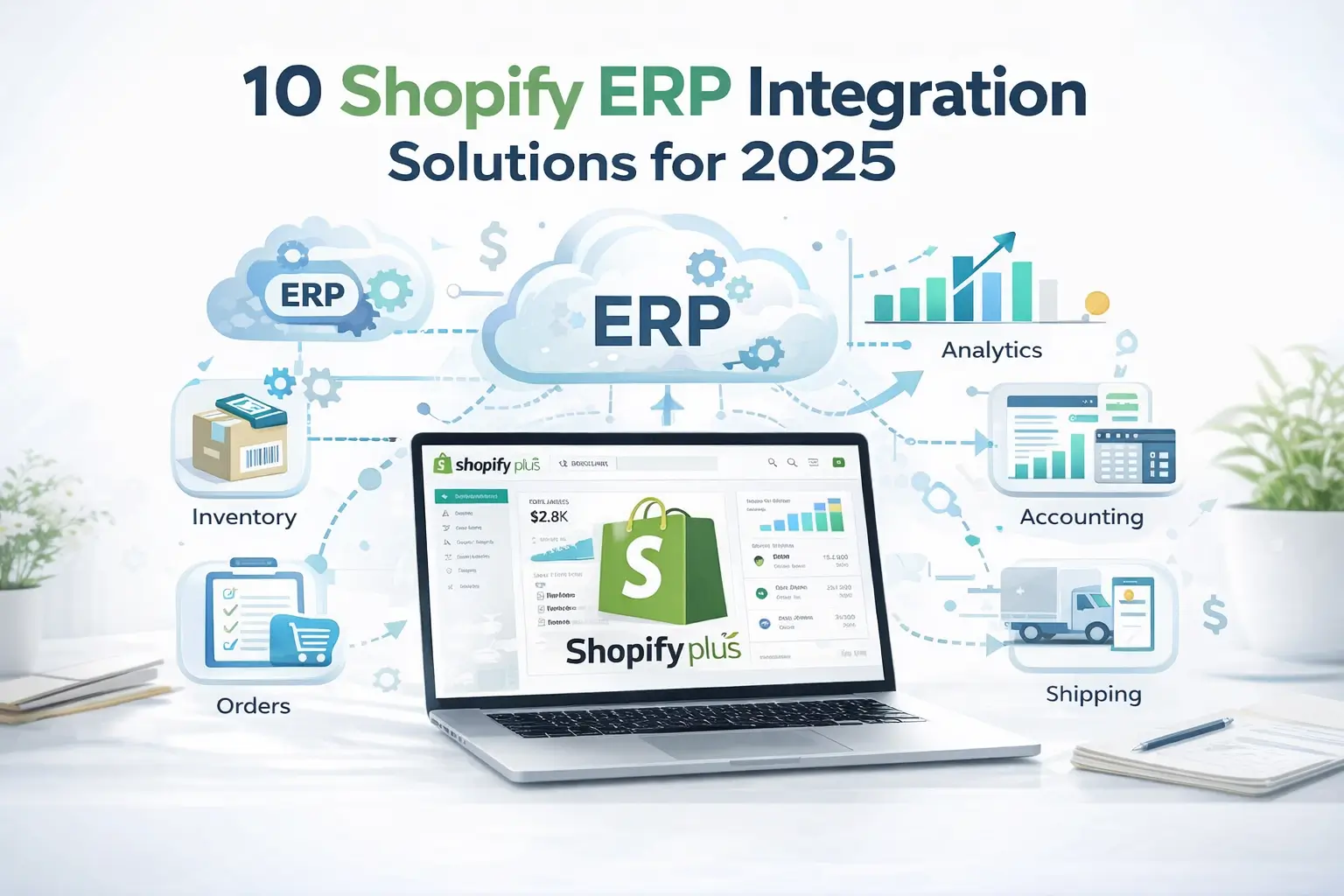


Managing an ecommerce business becomes increasingly complex as your Shopify store grows. Tasks like tracking inventory, managing orders, handling shipping, maintaining accounting records, and organizing customer data often require multiple tools and platforms.
Without proper integration, managing all these systems can quickly become overwhelming.
This is where Shopify ERP integrations play a crucial role.
By connecting your Shopify store with an Enterprise Resource Planning (ERP) system, you can centralize operations, automate workflows, and improve overall efficiency. These integrations help businesses save time, reduce manual work, and focus more on scaling their operations.
In this guide, we will explore 10 powerful Shopify ERP integration solutions for 2025 that can streamline your ecommerce operations and support business growth.
1. NetSuite ERP
NetSuite ERP is a cloud-based business management platform designed to simplify and automate business operations. It provides organizations with real-time visibility into financial performance and operational data.
This comprehensive solution combines multiple essential business functions within a single system, including accounting, inventory management, order processing, supply chain management, and warehouse operations.
With its centralized platform, NetSuite enables businesses to manage different departments efficiently while gaining valuable insights into overall performance and profitability.
2. Microsoft Dynamics ERP
Microsoft Dynamics is a powerful ERP solution that helps businesses manage their daily operations while improving productivity and collaboration.
The platform automates important business processes and provides intelligent tools that allow companies to focus on innovation and growth.
Key Features
AI-Powered Automation
Uses artificial intelligence to automate routine tasks and enhance customer interactions.
Microsoft Ecosystem Integration
Seamlessly connects with Microsoft tools like Office 365, Power BI, and Azure.
Flexible Customization
Adapts easily to different industries and business requirements.
Department Connectivity
Connects departments such as finance, sales, manufacturing, and supply chain to improve coordination.
Data-Driven Insights
Offers powerful analytics to help businesses make smarter decisions.
3. Brightpearl
Brightpearl is a cloud-based ERP platform designed specifically for wholesalers, distributors, and omnichannel retailers.
It simplifies retail operations by integrating online stores, warehouses, and physical retail locations into one centralized system.
Brightpearl automates several critical back-office processes, including:
- Accounting
- Order management
- Inventory tracking
- Sales operations
- Customer relationship management (CRM)
Since its acquisition by Sage in 2022, Brightpearl has become part of a larger ecosystem that integrates with Sage Intacct, providing advanced accounting capabilities.
The platform also helps businesses improve customer experiences, manage returns efficiently, and track profitability with real-time analytics.
4. Acumatica
Acumatica is a modern cloud-native ERP solution built for growing mid-sized businesses. It provides industry-specific features designed to connect different areas of a company’s operations.
Key Features
Easy Integration
Connects with existing business tools and software.
Team Collaboration
Modern workflows improve communication between departments.
Anytime Access
Users can access data from any device at any time.
Customization Options
Low-code and no-code tools allow businesses to personalize workflows.
Scalable Infrastructure
Resources and user access can grow with your business.
Automation & Insights
Centralized data provides real-time insights and automated workflows.
Compliance Support
Helps businesses comply with standards such as GDPR, SOC, and PCI DSS.
5. Oracle ERP
Oracle Fusion Cloud ERP is a modern cloud-based solution designed to help enterprises scale efficiently. It provides a secure and intelligent platform that integrates various business applications into one system.
Key Features
User-Friendly Interface
Simple and intuitive interface for easy adoption.
Strong Security Measures
Enterprise-level security for protecting sensitive data.
Integrated Business Applications
Improves collaboration and productivity through unified systems.
AI and Automation
Automates repetitive processes using machine learning and AI.
Advanced Analytics
Real-time reporting and analytics help improve decision-making.
Mobile Accessibility
Users can access business data and collaborate on the go.
6. QuickBooks Enterprise
QuickBooks Enterprise is an advanced business management platform that helps organizations streamline operations and financial management.
It integrates easily with several essential business tools, including payroll systems, payment processing platforms, time tracking applications, and inventory management software.
Key Features
- Advanced financial reporting
- Improved inventory and warehouse management
- Flexible pricing strategies
- Simplified payroll processing
- Team time-tracking tools
- Salesforce CRM integration
- Ecommerce platform connectivity
These features allow businesses to gain deeper operational insights and improve efficiency.
7. Odoo ERP
Odoo is an all-in-one business management software that supports companies across many industries. The platform combines multiple applications into a single integrated system.
Key Features
Modular Architecture
Businesses can choose modules for accounting, CRM, ecommerce, manufacturing, project management, and more.
Integrated Platform
Modules work together to ensure smooth data flow and a unified business overview.
Flexible Deployment
Available as both cloud-based and on-premise solutions.
User-Friendly Design
Simple interface that is easy to navigate and customize.
Highly Scalable
Suitable for startups, mid-sized companies, and large enterprises.
8. Aptean
Aptean provides industry-specific ERP software designed primarily for manufacturers and distributors.
The platform offers specialized solutions tailored to different sectors.
Key Solutions
Process Manufacturing ERP
Designed for industries such as chemicals, pharmaceuticals, and food production.
Discrete Manufacturing ERP
Supports businesses that manufacture individual products like machinery or electronics.
Food & Beverage ERP
Helps manage recipes, regulatory compliance, and product traceability.
Distribution ERP
Optimizes supply chain operations and inventory management.
These solutions allow businesses to manage complex manufacturing and distribution processes more efficiently.
9. Apprise ERP
Apprise ERP is an end-to-end platform designed for distributors and importers dealing with consumer goods.
It provides businesses with powerful tools to manage complex distribution operations with minimal customization.
Key Features
- Real-time reporting on profitability, suppliers, and product performance
- Demand forecasting with seasonal trends and lead-time analysis
- Accurate profitability calculations including taxes and royalties
- Efficient order processing and shipping management
- Simplified chargeback handling
- Integrated EDI services
- Built-in import and warehouse management tools
- Available as both cloud and on-premise deployment
10. BlueCherry
BlueCherry is a specialized ERP system developed for the fashion, apparel, and footwear industries.
It helps businesses manage critical operations within the fashion supply chain.
Key Features
Order Management
Processes customer orders efficiently to ensure timely delivery.
Production Planning
Manages raw materials, manufacturing processes, and finished products.
Inventory Management
Synchronizes inventory levels and order tracking across systems.
As ecommerce businesses grow, managing orders and shipments can become challenging. BlueCherry integrates with fulfillment providers and additional software tools to streamline logistics and operational processes.
Final Thoughts
Implementing an ERP integration is one of the most effective ways to optimize operations in a growing Shopify store. By connecting your ecommerce platform with a powerful ERP system, businesses can automate repetitive processes, improve data accuracy, and gain valuable insights into their operations.
The right ERP solution can significantly improve productivity, enhance decision-making, and provide better control over your business processes.
As your Shopify store scales, investing in a reliable ERP integration will help ensure smoother operations and allow you to focus on what truly matters—expanding your business and delivering exceptional customer experiences.